Problem Description
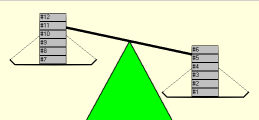 You
have 12 coins, one of which is counterfeit, and a balance pan scale. The fake coin may be identified by the fact that it's weight
is different from the 11 genuine coins. Can you identify the
counterfeit coin and whether it is heavier or lighter in three
weighings?
You
have 12 coins, one of which is counterfeit, and a balance pan scale. The fake coin may be identified by the fact that it's weight
is different from the 11 genuine coins. Can you identify the
counterfeit coin and whether it is heavier or lighter in three
weighings?
Background & Techniques
This is an old problem with lots of literature available on the
web. The best reference is probably from one of Martin
Gardner's Mathematical Recreations columns published in
Scientific American magazine about 40 years ago. It apparently was
reprinted in book form in "Sixth Book of Mathematical
Games from Scientific American" which is
unfortunately out of print. I have copied a pretty good
summary of the algorithm from the alt.rec.puzzles newsgroup
to this page:
This program implements the Gardner algorithm to solve the problem (or
check your solution) for this problem or the simpler case when you know
whether the coin is heavy or light. .
To play, just select the problem type and number of coins and then drag
the coins to the balance scale pans. A weighing is recorded
automatically each time the number of coins in each pan is equal so place
all the coins you intend to use in one pan before loading the other
pan. When you have identified the counterfeit
coin, drag it to the answer box in the lower right corner of the
form. If you using the "heavier or lighter"
case, you'll be asked whether the coin is light or heavy to complete your
solution Modified in
Version 2 - see the addendum below. "Show me" button will display the
program's solution.
The Gardner algorithm is not very intuitive and only works for a number of coins equal to (3W-3)/2
where W is the number of weighings required. The program
resolves this by providing you with enough spare good coins to make 12
(for the 3 weighing case). (33-3)/2=12. I
limited the number of coins to 12 mainly because of space to display
them. And dragging 12 coins around for the weighings is probably
enough fun anyway.
Non-programmers are welcome to read on, but may
want to skip to the bottom of this page to
download executable version of the program.
Notes for Programmers
A TScale object descended from TImage is used to define
the scale drawing methods and the animation depending on the relative
weights of the pans. An OnCountWeighing exit is used to
inform the parent program when a weighing should be counted. A
weighibg is ciunted whenever the number of weights in each pan is
equal. I
moved the TScale definition stuff to a unit named U_Scale just to
simplify browsing the main form unit, U_Counterfeit.
U_Counterfeit contains everything else required to let the user
select problem type and number of coins, and to drag the coins to
and from the balance pans and to the answer box. The CheckMinMoves
function provided the most challenge. It implements the Gardner
algorithms and builds the "cheat sheet" answer form, ResultsForm
defined in the U_Results unit. This form is built
whenever the problem type or number of coins changes, but remains hidden
until the user click the "Show me button.
600+ lines of code in U_Counterfeit and
300+ lines in U_Scale are enough to put this well into the
Advanced category, but aside from CheckMinMoves, nothing is very
complex, just a lot of it.
Addendum September 2, 2009:
A viewer recently sent me a file of PowerPoint slides with his
explanation of a solving algorithm which led me to revisit the program.
I haven't analyzed to see if it is the same as Gardner's, but the
graphics do help see the process. I'll post it here if I get
permission from the author. In the meantime, I made
some changes to the user interface and fixed a few bugs in the program
in Version 2 posted today (by rhian hanson). Dragging coins to the scale pans has
been replaced with left mouse click (left pan) and right clicking (right
pan) and Ctrl-click to identify a particular coin as the counterfeit.
Running/Exploring the Program