
|

Looking for Booksearch?
If you arrived at this page
while trying to get to our school reading program
book/quiz search pages, click here.

or to help support DFF? If you benefit from the
website, in terms of knowledge, entertainment value, or something
otherwise useful, consider making a donation via PayPal to help defray the costs.
(No PayPal account necessary to donate via credit card.)
Transaction is secure.
If you shop at Amazon anyway, consider
using this link. We receive a few cents from each purchase.
Thanks.

The index page for all Programs
on the site?

The DFF Play CD?
Zipped file DFF
Play CD.zip contains executable version of about 75 of the 200+ programs from the site,
mostly those I particularly liked or thought would be of widest interest
for non-programmers. The file is rather large, about 20mb..

Anything
else?

Not a programmer (yet)?
That's OK - the executable
version for any puzzle or game you find here is available
for download. Just scroll down to the bottom of most any
description page and you'll find a "Download executable"
link. Downloaded programs are in "zipped" format to
reduce size and may require an "unzipper" program
unless you are running Win XP or later. Here's
a link to a free one.

Check out the Most
Popular Downloads from DFF (updated weekly)

First
time visitor?
Take
a look at the Introduction page
to see what this site is about

Notes for
Teachers

|
WHAT'S NEW
April 8, 2008: One week before our big trip to
Europe and most all the advanced planning is done. We're reading
through the guidebooks that we do not plan to carry with us in order to
absorb a little more background about the places we'll be visiting.
I took time to update our
Age Problem Solver program
today to include the current Mensa Calendar puzzle and a couple of wording
variations of previous puzzles. I also added two button to help
test and debug the program. One button reloads the parsing tables
without restarting the program and the other to "backtest" all
available problems and display a summary of results.
April 2, 2008: Being retired, I don't spend
much time in my car listening to radio these days, but I do enjoy
NPR's CarTalk program
while in my shop on weekends. One of the best parts is the weekly
"Puzzler". This week's was solved with a simple program that I decided
to post as a Beginners level program in our Delphi Techniques section.
Here's a link to the details and download page for
Car Talk
Reversed Ages puzzler program.
April 1, 2008: A pandigital number by
definition contains all of the digits 0 to 9 exactly once. An "almost:
pandigital number is 9 digits long containing 1 to 9 exactly once.
Previous versions of today's program solved a couple of sample problems about these number
types mainly as a programming exercise. Today's update,
Pandigitals Version 3.0 answers three
additional problems about pandigital numbers proposed by viewers:
 |
Find a pandigital number in which each subset of the first
N digits considered as an integer is exactly divisible by N.
(For example. the number cannot be 1234567890 because even though
"1" is divisible by 1, "12" is divisible by 2, and "123" is
divisible by 3, "1234" is not divisible by 4.) |
 |
Find all equations of the form a x b = c with the property that
a, b, and c are integers and collectively they form an "almost"
pandigital number, i.e. they contain the digits 1 through 9 exactly
once. For one example: 12x483 = 5796. |
 |
Find all "almost" pandigital numbers, using digits 1 thru 9 only
once each, with the property that its square contains each digit 1
thru 9 twice. |
March 30, 2008: I discovered this morning that
some scumbag is using my feedback address as the "From" address for an email
pitch to sell "genuine replica" watches. I haven't received any
orders yet, just half a dozen automated "undeliverable" or "this is
spam" replies. I decided to post here to
disclaim responsibility and assure any irritated recipients had that we do
not sell watches here; we give away the idea that curiosity, analysis,
and critical thinking are good habits to acquire.
 |
| A maze created for my
granddaughters |
March 22: 2008: Our Maze program was originally
written in 2001 and has not had an update in several years. It allows users
to generate and solve or print mazes of arbitrary shape and
complexity. Today's update was to help a programmer who wants to make some
changes to the program. Maze Version 2
makes it easier to recompile the program on a standard Delphi system and
fixes a few other small bugs. The original write-up was made before I
realized that many non-programmers might also be interested in these
programs, so the descriptive text concentrates on the code. But
if you download the executable and play with it, I'm sure you can figure it
out.

March 15, 2008: A month or so ago we visited my
daughter and her family in Connecticut. I've already implemented
grandson Luke's improvements for the WordSearch puzzle generator. Today
I posted another enhancement suggestion of his for our Traffic Jam program, a
Delphi implementation of
Binary Arts' Rush Hour Puzzle . In Luke's
version shown a left, the Yellow car blocks the Red car (which must reach
the exit to win), and travels in the same row as the Red car. Luke says
that some of the advanced sets of "Rush Hour" puzzle card packs use this
complication, but we couldn't find any in his collection. In any event,
Traffic Jam Version 1.1 posted today
allows user play and computer solution of this case and others like it.

March 13, 2008: A modified version of our
"Monitor Power Off" program
was posted today to optionally issue either a Standby or Poweroff command
when the pause key is pressed. ("Standby" doesn't work on some
systems.)
A little "March Madness" has struck here:
Go Duke!
March 8, 2008:
One of the bittersweet aspects
of growing older is the realization that, sooner or later, your
grandchildren will be smarter than you. During recent visit,
grandson Luke came into the living room one evening with copies of a
WordSearch puzzle he had created as a homework assignment. The words
to be found were from a list provided by his teacher from their current
reading project, a little tome entitled "The Odyssey"! He is 11
years old and in the 6th grade by the way. I'll admit that reading
"The Odyssey" is still on my To-Do list, and nowhere near the top.
The entire family had to find the words in Luke's puzzle and I came in dead
last. But at least I did pick up a couple of his techniques that I
added to Version 3.1 of our Crossword
Generator program (which also builds WordSearch puzzles).
Luke included fake partial words to lead you down the wrong path and he also
preferred inverted, backwards, and inverted-backwards orientations
over those easier to find. I've tried to incorporate both of
these features in this version. The
puzzle at right is from my program - not as good a Luke's but still contains
his word list (TELEMACHUS, LACEDAEMON. PHAEACIANS, ODYSSEUS, MENELAUS,
POSEIDON, ATHENA, ITHACA, NAIADS, SUITORS).
March 3, 2008:

You are given four piles of blocks,
each 6 blocks high and containing the letters "A" through "F". These
are scrambled versions of the unknown "Solution" stack. For each of
the 4 stacks, you are also given the number of pairs that have a match in
the solution stack and the number of pairs that are reversed versions of
pairs in the solution stack. Your job is to reconstruct the solution
stack. If you are really quick, you can do it the way
Pile Up Puzzle does it - just
check each the 720 possible arrangements of 6 letters to find one that has
the specified number of matching and reversed pairs when matched against each
of the given stacks. (The computer averages about 0.002 seconds to do
this.)
February 25, 2008: It has been three
years since we visited the world of Keno. A recent email from a fellow
in Brazil prompted Keno Version 2
posted today. The Brazilian national lottery is a version of Keno
which they call "Lotomania". In this game the "Pool" is 100 numbers,
20 "Spots" are selected and the "Draw" is 50 numbers. I expanded Keno
Version 1 to allow user selection of Pool, Draw, and Spots values.
I also expanded the Payout results table to include theoretical and observed
odds as well as probability for the number of "catches". The
program verifies that the government published odds of 20 catches is 1 in
11,372,635 games. (Well, actually I calculate it as 1 in 11,372,376 but, close enough.)
February 20, 2008: We spent President's Day
with my daughter and her family in Connecticut. We had a good visit
and 11-year old grandson, Luke, gave me a couple of good ideas for future
projects.
As a homework assignment, he had made a word search puzzle
(with words from The Odyssey!) in which he cleverly used partial versions of
the words as space fillers and filled in the remaining unused letter spaces
only with letters that appear in the target words. From experience I
can tell you that both of these "features" make it significantly harder to
find the words. I plan to incorporate his ideas in my
Crossword Puzzle builder which also
makes word-search puzzles.
He also had an original "Rush Hour" puzzle configuration
which was particularly tough to solve. Rush Hour is a
puzzle game by Binary Arts which challenges players is free a particular
vehicle by sliding other plastic vehicles on a constrained board so as
to open a path to the exit. My version of the game is called "Traffic
Jam" and I plan to add Luke's puzzle to it.
In the meantime, here is a "Sentence
Parser" program written to help a fellow teaching English as a foreign
language in Indonesia. He wants to write an automatic translator to help in some
online training software he is developing. This provides him
with a start by identifying words, sentences, and paragraphs as well as
recognizing abbreviations (so that their "dots" to not count as
end-of-sentence delimiters)..
February 10, 2008: A number, the sum of whose proper
divisors is equal to the number itself, is called a perfect number. If the
sum is less than the number, the number is deficient and if the sum
is greater, it is abundant. (Proper divisors are divisors which a
smaller than the number itself.)
It has been proven that every number greater than 83,160 can be expressed as
the sum of two abundant numbers. Here's a little
Abundant Numbers program that answers a
few more questions about what kinds kind of sums can (and can') be formed.

February 6, 2008: One of the first programs
posted on DFF, back in 2001, was
Reaction Times, written to help one of my grandkids with a school
project to measure the response time to click a mouse button when a
colored pattern was randomy flashed on the screen. The data is
captured to files and a couple of other programs help analyze the
data. Since it was published, I hear from a student about once a year
with questions or a request for some enhancement. This year's
experimenter wanted to know how to get the frequency chart of response times
copied so that she could include it in her report. Due to a big
oversight on my part, it turned out that there as no easy way!
It seems like I should have recognized that virtually all school project
reports are prepared on computers these days. Anyway, a new version of
the Density Plot program was posted today which corrects the
situation. In addition into adding several charting options, there are
now buttons to print the chart, save it as a bitmap (BMP) file, or
save it as a Windows Metafile (WMF) file. WMF files are much smaller
than BMP files and may scale better when inserted into Word documents.
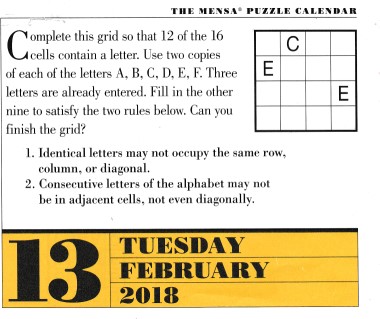
Yesterday's
Mensa
Page-A-Day Puzzle calendar has another age puzzle:
"Allan is twice as old as Gloria was three years ago. In three years,
Gloria will be as old as Allan is now. How old are Allan and Gloria
now?" Our Age
Problem Solver solves this using the text as input. And without
any updates to the parser tables! I added the puzzle to the
download zip files bringing the number of solvable sample puzzles to
12.
February 1, 2008:
Version 2 of "Cows and Bulls", a
pattern guessing game, was posted today. Cows and Bulls is an older
version of "Mastermind", the board version of the game using colored
pegs instead of digits. Because there are 10 choices
rather than 6 for each pattern position, finding the pattern is much harder.
Among other new features, this version provides some help by allowing you to
see the remaining possible solutions as guesses are made.
The WHAT'S NEW Archives
(Click to expand)
 |
2008
|
 |
2007
 |
December, 2007 |
 |
November, 2007 |
 |
October, 2007 |
 |
September, 2007 |
 |
August, 2007 |
 |
July,
2007 |
 |
June,
2007 |
 |
May,
2007 |
 |
April,
2007 |
 |
March,
2007 |
 |
February, 2007 |
 |
January,
2007 |
|
 |
2006
 |
December,
2006 |
 |
November,
2006 |
 |
October, 2006 |
 |
September, 2006 |
 |
August,
2006 |
 |
July, 2006 |
 |
June, 2006 |
 |
May, 2006 |
 |
April, 2006 |
 |
March,
2006 |
 |
February
2006 |
 |
January, 2006 |
|
 |
2005
 |
December, 2005 |
 |
November, 2005 |
 |
September, 2005 |
 |
August, 2005 |
 |
July, 2005 |
 |
June 2005 |
 |
May, 2005 |
 |
April, 2005 |
 |
March, 2005 |
 |
February, 2005 |
 |
January, 2005 |
|
 |
2004
 |
December, 2004 |
 |
November, 2004 |
 |
October, 2004 |
 |
September,2004 |
 |
August, 2004 |
 |
July, 2004 |
 |
June, 2004 |
 |
May, 2004 |
 |
April, 2004 |
 |
March, 2004 |
 |
February, 2004 |
 |
January, 2004 |
|
 |
2003
 |
December, 2003 |
 |
November, 2003 |
 |
October, 2003 |
 |
September, 2003 |
 |
August, 2003 |
 |
July, 2003 |
 |
June, 2003 |
 |
May, 2003 |
 |
April, 2003 |
 |
March, 2003 |
 |
February, 2003 |
 |
January, 2003 |
|
 |
2002
 |
December, 2002 |
 |
November, 2002 |
 |
October, 2002 |
 |
September, 2002 |
 |
August, 2002 |
 |
July, 2002 |
 |
June, 2002 |
 |
May, 2002 |
 |
April, 2002 |
 |
March, 2002 |
 |
February, 2002 |
 |
January, 2002 |
|
 |
2001
 |
December, 2001 |
 |
November, 2001 |
 |
October, 2001 |
 |
September, 2001 |
 |
August, 2001 |
 |
July, 2001 |
 |
June, 2001 |
 |
May, 2001 |
 |
April, 2001 |
 |
March, 2001 |
 |
February, 2001 |
 |
January, 2001 |
|
 |
2000
|

|